The Hidden Cost of Fragmented Signals in Product Management
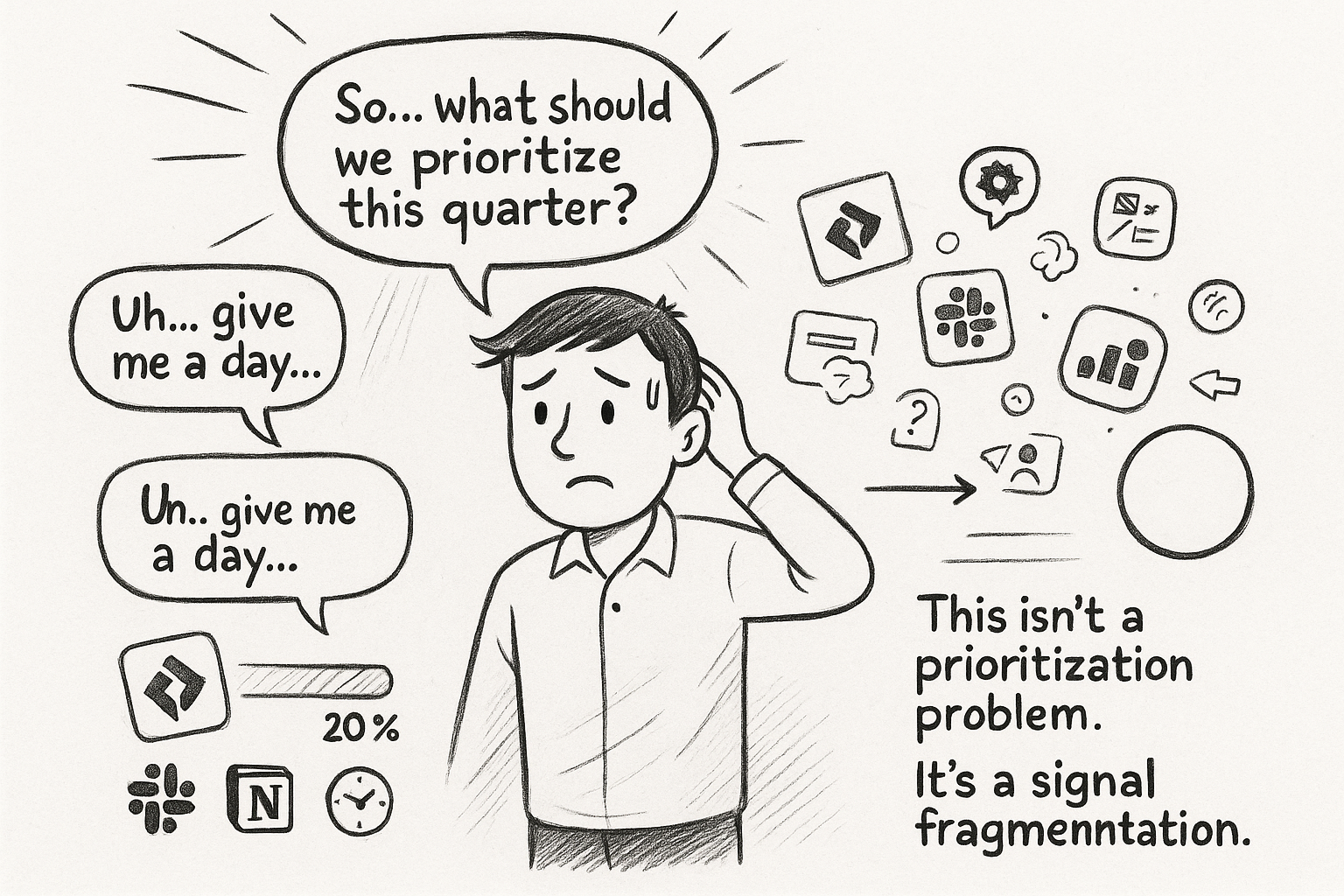
Imagine this scenario. You’re a product manager building the roadmap for the next quarter. You already have:
- 10 feature requests from top customers
- Product telemetry showing critical gaps and metrics moving in the wrong direction
- High-severity bugs demanding immediate attention
- Pressure to stay ahead of competitors
- The need to understand market and technology trends
Individually, these signals make sense. Together, they create confusion.
This is the hidden cost of fragmented signals in modern product management.
📌 Key Takeaways:
Product managers spend ~70% of their time gathering fragmented signals (customer feedback, bugs, telemetry, competitor data, market trends) across disconnected tools
Only ~30% of PM time goes to actual strategic thinking, creating an imbalance that weakens roadmap confidence
Competitor analysis alone can take days or weeks, involving 10-15 browser tabs, demos, articles, and reports
The goal: flip the ratio so PMs spend less time on data archaeology and more time on strategic decisions
Fragmented signals lead to roadmaps driven by urgency rather than insight, with prioritization debates instead of clarity
Cruxtro unifies customer feedback, product data, and market insights into one AI-powered product roadmap that drives outcome
Why Roadmapping Feels Harder Than It Should Be
To make a confident roadmap decision, you’re expected to do thorough analysis—especially competitor and market research.
That usually means:
- Opening 10–15 browser tabs to scan competitor features
- Watching demo videos and walkthroughs
- Reading comparison articles and changelogs
- Reviewing customer feedback across multiple platforms
- Going through industry and technology reports
Depending on depth and number of competitors, this alone can take days—or even weeks.
And competitor analysis is just one input.
The 70/30 Problem in Product Management
Across teams, a pattern emerges:
- ~70% of a PM’s time → Gathering and reconciling data
- ~30% of time → Actual strategic thinking
That imbalance is not because PMs lack strategic ability.
It’s because signals are scattered everywhere.
Why Product Managers Spend So Much Time Gathering Data
1. No Single Source of Truth
Customer feedback, bugs, feature requests, telemetry, competitor insights, and market trends live in different tools and formats.
PMs are forced to manually stitch everything together.
2. Customer Insights Are Overwhelming
Sales calls, support tickets, NPS responses, reviews—each is valuable, but disconnected.
Without context, volume turns into noise.
3. Industry Reports Add Complexity, Not Clarity
Multiple reports often say similar things differently—or contradict each other—leaving PMs to interpret rather than act.
4. Product Analytics Require Heavy Manual Work
Telemetry only becomes useful after you define hypotheses, segment users, and cross-reference qualitative signals.
This is deep work—but it happens after hours of preparation.
The Strategic Cost of Fragmentation
By the time you finally sit down to think strategically, you’re already cognitively drained.
The result?
- Roadmaps driven by urgency instead of insight
- Prioritization debates instead of clarity
- Decisions that feel defensible—but not confident
This leads to a critical question:
If only 30% of your time is spent on strategy, how strong can that strategy really be?
This Is Not a Tool Problem. It’s a Signal Problem.
Product teams don’t fail because they lack dashboards.
They fail because signals aren’t connected.
When signals are fragmented:
- Patterns stay hidden
- Trade-offs feel risky
- Strategy becomes reactive
What PMs actually need is connected truth.
How Cruxtro Changes the Game
Cruxtro is built around a simple but powerful idea:
Product managers should spend time thinking, not collecting.
Instead of forcing PMs to jump between tools, Cruxtro connects fragmented signals into one intelligent product workspace.
What Cruxtro Does Differently
- Unifies customer feedback, bugs, feature requests, and market insights into a single AI-powered context
- Connects qualitative signals with quantitative telemetry, so insights don’t live in isolation
- Generates context-aware PRDs, user stories, and strategy inputs from real data—not assumptions
- Reduces competitor and market research time by synthesizing insights instead of scattering them
- Keeps strategy, discovery, and execution aligned in one continuous flow
The result?
PMs flip the ratio:
- Less time gathering data
- More time thinking strategically
- Higher confidence in roadmap decisions
From Information Archaeology to Strategic Clarity
Product managers don’t need:
- More reports
- More dashboards
- More disconnected tools
They need connected signals that surface what actually matters.
When signals are unified:
- Strategy becomes clearer
- Prioritization becomes faster
- Roadmaps reflect conviction, not compromise
Cruxtro exists to remove the invisible tax of fragmentation—so product teams can focus on building the right things, not just managing information.