Why PMs Need Context-Aware Assistants, Not Just ChatGPT Windows
The promise of AI assistance for product managers is everywhere. Open a ChatGPT window, describe your product challenge, and get instant insights. It sounds perfect—until you realize you're copying and pasting the same context into every conversation, explaining your product roadmap for the hundredth time, or desperately searching through old chat threads to find that brilliant strategy you discussed last week.
The reality is that generic AI chat windows, while powerful, weren't built for the way product managers actually work. And that gap between promise and practice is costing PMs valuable time and cognitive energy every single day.
Key Takeaways
- Generic AI chat windows force PMs to repeatedly re-explain context, wasting time and cognitive energy that could be spent on actual product work
- Context-aware assistants maintain persistent understanding of your product landscape, customer signals, decision history, and working style—eliminating the need to start from zero each time
- The most valuable AI insights come from pattern recognition across your work, which is impossible when every conversation is isolated and disconnected
- Context awareness compounds over time, getting smarter about your specific needs and proactively offering relevant frameworks and insights
- Product management is fundamentally context-rich, involving customer feedback, stakeholder alignment, competitive intelligence, and strategic trade-offs that all need to connect
- Context-aware assistance transforms AI from a writing tool into strategic infrastructure that helps maintain team alignment and serves as shared product intelligence
- The real competitive advantage isn't more powerful models—it's systems that understand the persistent, contextual nature of product work
The Context Problem Every PM Faces
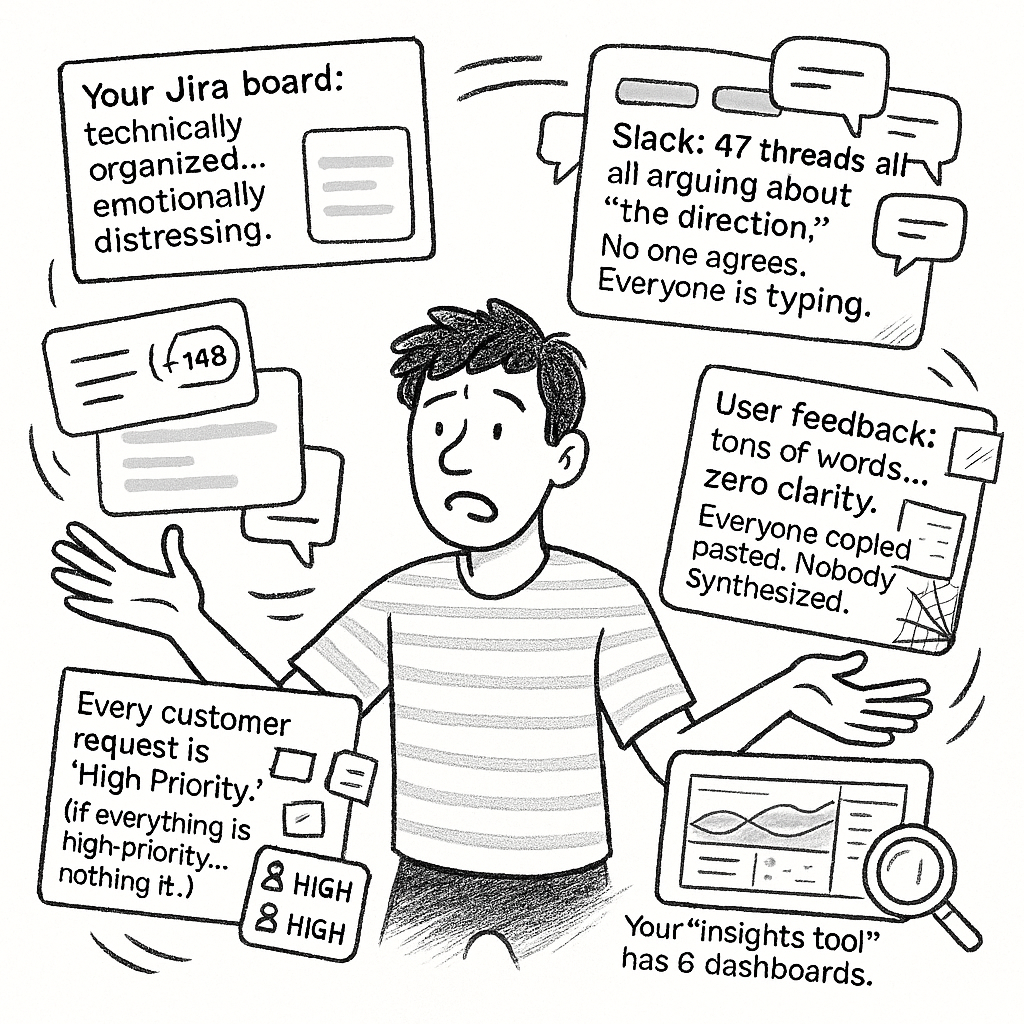
Product management is fundamentally a context-rich discipline. You're juggling customer feedback from multiple channels, aligning stakeholders with different priorities, tracking competitive movements, managing technical constraints, and making strategic trade-offs—all while keeping dozens of threads in your head simultaneously.
When you turn to a generic AI assistant, you're starting from zero every single time. Want to brainstorm feature prioritization? You need to explain your product, your market, your current roadmap, your team's capacity, and your strategic goals before you can even begin the actual conversation. By the time you've provided enough context, you've already spent 10 minutes typing—and that's assuming you remembered to include everything relevant.
This context reset isn't just inconvenient. It fundamentally limits how AI can help you. The most valuable insights come from understanding patterns across your work, connecting dots between conversations, and maintaining continuity in your thinking. None of that is possible when every chat is an island.
What Context-Aware Actually Means
A context-aware assistant doesn’t just remember what you said five messages ago. It understands the ongoing reality of your product work—and builds on it over time.
This is the difference between using AI as a prompt-and-response tool and using it as part of your product system.
A truly context-aware assistant understands:
Your product landscape.
It knows what you’re building, who you’re building it for, and what success looks like. When you reference “the Q2 roadmap” or “the onboarding gap,” you don’t need to re-explain the background—because the context already exists.
Your signals, not just your words.
Customer feedback, feature requests, bugs, telemetry, and competitive insights aren’t treated as separate inputs. They’re connected. Patterns emerge not because you asked the right prompt, but because the system understands how these signals relate.
This is the problem Cruxtro was built to solve.
Instead of forcing product managers to repeatedly paste context into generic chat windows, Cruxtro maintains a persistent understanding of your product, decisions, and trade-offs—so every interaction starts where your thinking actually is, not where a blank prompt begins.
Your decision history.
It remembers why certain features were deprioritized, what assumptions guided earlier choices, and what changed when outcomes didn’t match expectations. Over time, this institutional memory becomes more valuable than any single response.
Your working style.
It adapts to how you structure PRDs, how detailed your team prefers specifications, and how you communicate with stakeholders—so assistance feels aligned with how you already work, not imposed on top of it.
This kind of awareness transforms AI from a clever writing assistant into something closer to a strategic thought partner—one that evolves alongside your product, instead of resetting every time you open a new chat window.
The Compound Benefits of Persistent Context
The difference between context-aware and context-blind assistance compounds over time in ways that aren't immediately obvious.
With a generic chat window, every interaction is transactional. You ask a question, get an answer, and move on. There's no accumulation of understanding, no building on previous insights, no pattern recognition across your work.
A context-aware assistant gets smarter about your specific needs with every interaction. It notices that you're repeatedly grappling with build-versus-buy decisions and starts proactively offering frameworks. It recognizes that your customer feedback is trending in a particular direction before you've fully articulated it yourself. It spots when your roadmap conversations are revealing tension between short-term revenue needs and long-term strategic positioning.
This accumulation of insight is particularly powerful for the pattern-matching work that defines great product management. You're not just getting help with individual tasks—you're developing a system that understands your product thinking and can genuinely extend it.
When Generic AI Actually Works Better
To be fair, there are absolutely times when a fresh, context-free AI conversation is exactly what you need. When you're exploring a completely new market, when you want an outsider perspective unconstrained by your assumptions, or when you're deliberately trying to challenge your existing mental models, starting from zero has real value.
The key is having the choice. A context-aware assistant should be able to operate in both modes—maintaining deep understanding of your work while also being able to step outside that context when valuable.
What This Means for Product Teams
The shift from generic AI windows to context-aware assistance isn't just about individual productivity. It changes what becomes possible for product teams.
When your AI assistant understands your product context, it can help maintain alignment across the team. It can ensure that customer insights from discovery conversations actually inform prioritization decisions. It can help new team members get up to speed by explaining not just what you're building, but why, with full historical context.
More fundamentally, it shifts AI from being a tool for generating individual outputs to being infrastructure for product intelligence. The context becomes a shared asset that makes the entire team more effective.
The Future of PM Assistance
We're still in the early days of understanding how AI can best serve product managers. But one thing is becoming increasingly clear: the most valuable assistance won't come from more powerful language models alone. It will come from systems that understand the persistent, contextual nature of product work.
The difference between copying your roadmap into ChatGPT for the dozenth time and working with an assistant that already understands your product strategy might seem small in any single moment. But across hundreds of interactions and countless decisions, it's the difference between AI as a clever tool and AI as a genuine extension of your product thinking.
The question isn't whether to use AI assistance—that ship has sailed. The question is whether you're building systems that actually understand your work, or just collecting a growing pile of disconnected chat transcripts.
For product managers drowning in context and starving for time, that distinction makes all the difference.
Ready to experience what truly context-aware product assistance feels like? Discover how Cruxtro helps PMs work smarter by understanding your product, your team, and your unique challenges.